Feature 01
Project Planning
Create projects with clear deadlines, tasks, and assignees — the whole team sees priorities in real time.
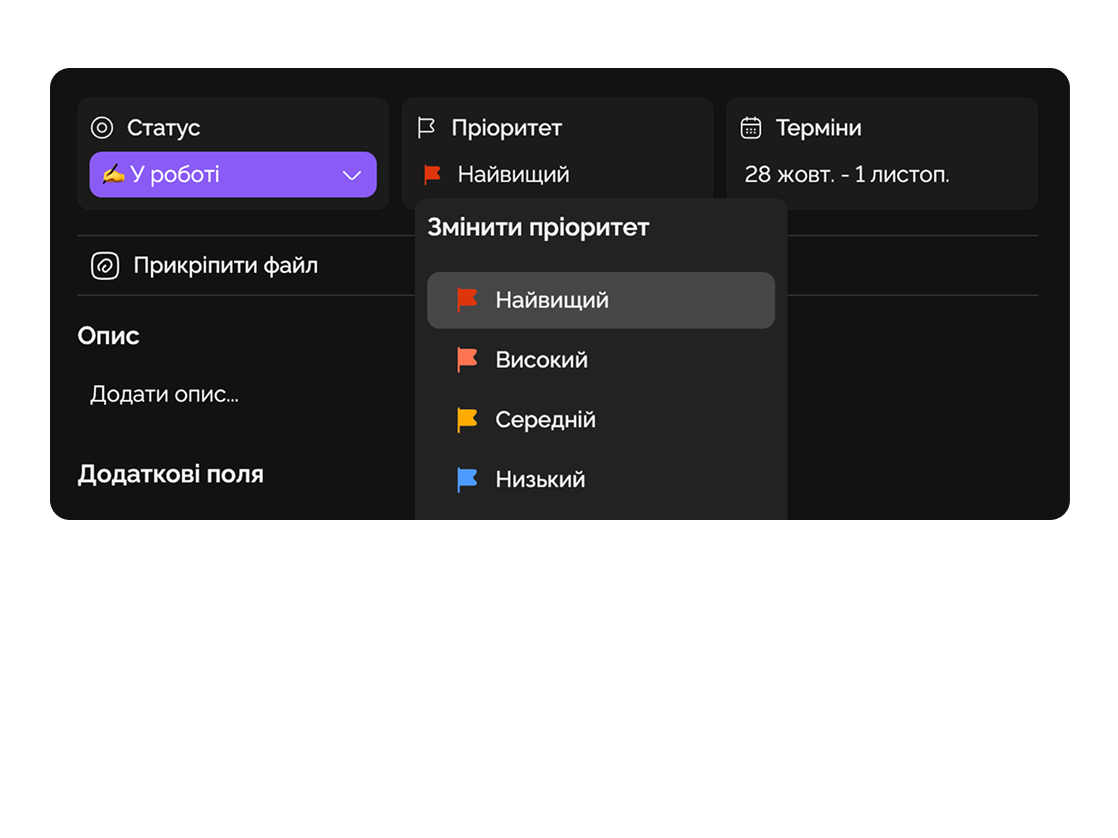
Easylim helps teams of 10 to 50 people manage projects, clients, and business areas efficiently in one place — no extra meetings or confusion.
Built for

By the numbers
−40%
time on coordination
customer data
5+
business lines in one place
Easylim CRM
100%
team-load visibility
2025 survey
Tools that help maintain focus, coordination, and the overall productivity of your team.
Feature 01
Create projects with clear deadlines, tasks, and assignees — the whole team sees priorities in real time.
Feature 02
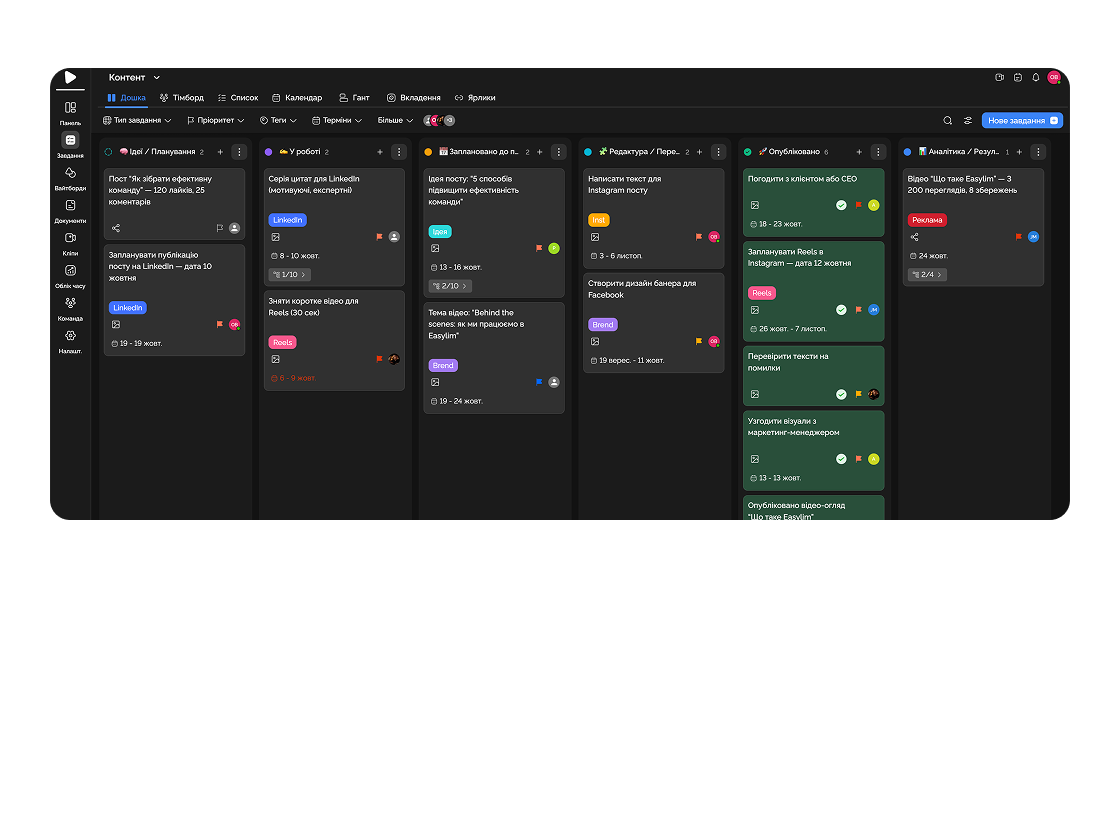
Organize the work of departments, clients, or business directions through flexible workspaces.
Feature 03
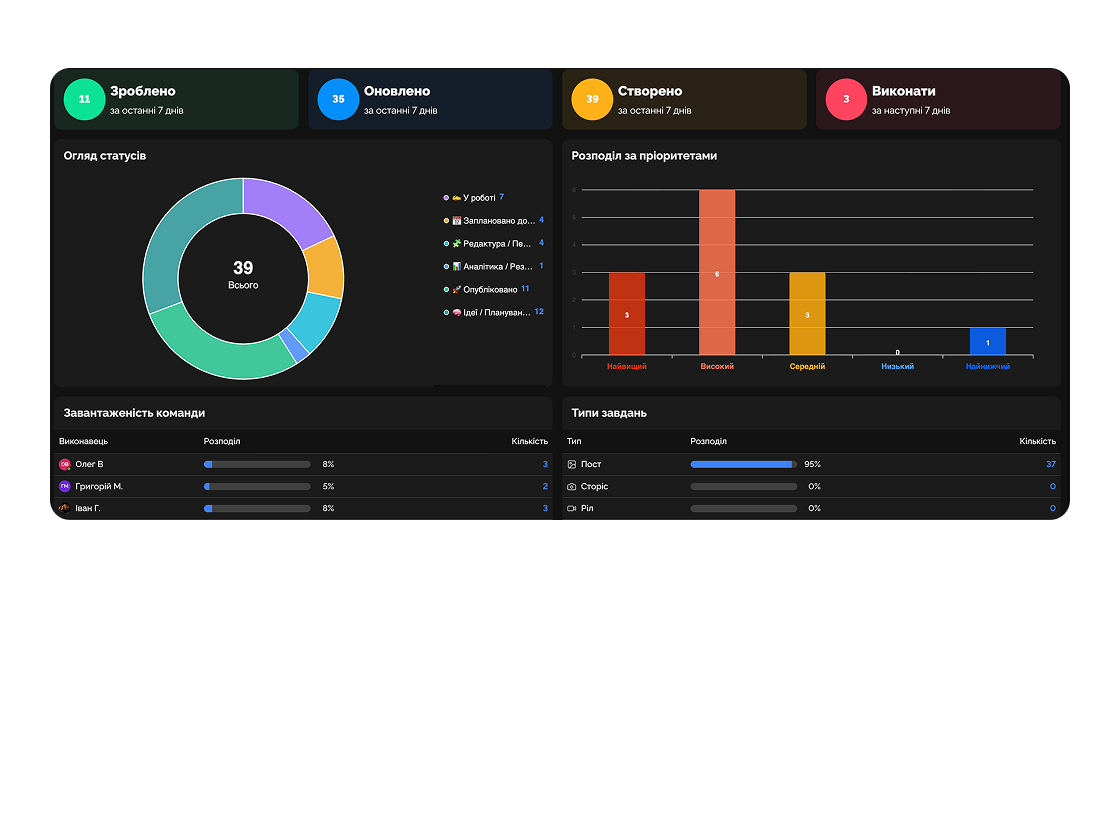
Track results, workloads, and the efficiency of each team member via intuitive dashboards.
Feature 04
Minimize chat chaos — communicate on tasks, discuss ideas, and document decisions in one place.

Manages multiple clients simultaneously: each project has its own tasks, deadlines, and team. Easylim synchronizes all directions.

Manages product development, technical support, and client requests in one environment — no need for dozens of separate tools.

Deep dive
5 chapters
Under 15 people everyone knows everyone and coordination happens in the hallway. Past 50 you need a formal process. The middle is the hardest band: enough teams that hybrid systems creep in, not enough people for a full enterprise stack. You need a tool that gives you structure without bureaucracy.
Розділ
At this size you already have 4-6 functional teams, and each rightly wants its own workflow. Sales wants pipeline stages. Engineering wants sprints. Marketing wants a campaign calendar. CS wants SLA-tracked tickets. The mistake is forcing them into one template. The right move is giving each team their own board but a shared reference system: shared customer tags, shared priority levels, shared terminology.
That way when sales says 'P0 enterprise', engineering sees 'P0 enterprise' with the same SLA, and CS sees the same label on the ticket. No translators between departments. You save hours a week that used to go to 'what do you mean by urgent?'
One leadership dashboard rolls KPIs from all teams onto one screen — MRR, MQL, sprint velocity, CSAT. The weekly leadership meeting becomes a five-minute status check, not a 40-minute slide war.
Розділ
The hardest type of work in a mid-sized business is a project that crosses 3+ teams. Classic example: launching a new self-serve checkout. Design mocks it, engineering builds it, customer success prepares the comms and documentation. If nobody owns the handoffs, the project drowns in 'when will it be ready?' and 'nobody told me it was done'.
The fix is a cross-functional view with explicit handoff markers. Design finishes the spec in W2 → it shows up automatically in the engineering backlog as 'ready to pull'. Engineering ships beta in W6 → CS sees 'time to prep comms'. No forum threads about status.
This is not a 200-row Gantt. It is three swim lanes (one per team) and 2-3 handoff markers. Anything more complicated means the project should be split into smaller pieces.
Розділ
At 15-50 people you cross the line where quarterly planning becomes necessary. Not because you love Silicon Valley templates, but because five teams can now pull in five directions and the CEO physically needs to see what those teams are doing together.
A working format: 3 objectives per quarter, each with 2-3 measurable key results. No more. If a team cannot point to one of the three objectives a task supports, the task probably should not happen this quarter. Harsh, but healing.
The mistake to dodge: OKRs as bureaucratic theatre. If you spend two weeks writing OKRs and never look at them until the next quarter, you are doing it wrong. Check progress weekly, adjust monthly. Otherwise OKRs are decoration.
Розділ
At 50 people you can no longer get away with 'everyone agreed in chat'. You need a paper trail to understand later why you spent $14K on a tool and who owned it. But a 5-step process with legal, finance, director, and CEO is also not for you — you are not a listed company.
A working format: two steps — manager → director. The manager owns team-budget fit and ROI. The director owns alignment with strategy. Every decision is captured in the system with reason, amount, date, and owner. A year later this is invaluable during an audit or a spend review.
Do not add a third 'finance reviews' step until you have a dedicated finance lead. Until then, finance is the CEO/COO, and they are already on step two. Do not invent complexity for its own sake.
Hire · Senior backend
Vendor SaaS · $4.2K/yr
Marketing budget · Q4
no 5-step gauntlet · still auditable
Розділ
Over-buying enterprise features at mid-size is a common sin. Single-tenant databases, custom contract terms, sandbox tiers — these are great when you have 500 employees and a financial client demanding dedicated infrastructure. At 30 people they slow you down and cost money.
What is worth having at 15-50: SAML SSO, baseline SOC2, a dedicated customer success manager. That covers 95% of reasonable IT security and operational reliability concerns. What is not: a separate database, formal DPAs with auditors, custom legal terms. If a customer demands those for a $20K deal, the deal is not worth the complexity.
If 15-50 already feels tight, look at the enterprise page. Triggers for the jump: formal governance, regular security audits, multi-year contracts with custom clauses, a dedicated IT function.
15-50 people · light structure
$22/seat
500+ people · heavy compliance
$120+/seat
add layers when growth demands · not before
Easylim connects to the apps your team already lives in.
Other segments
No card required. Free tier forever.


