Feature 01
Client Management
Record client data and control interactions with them.
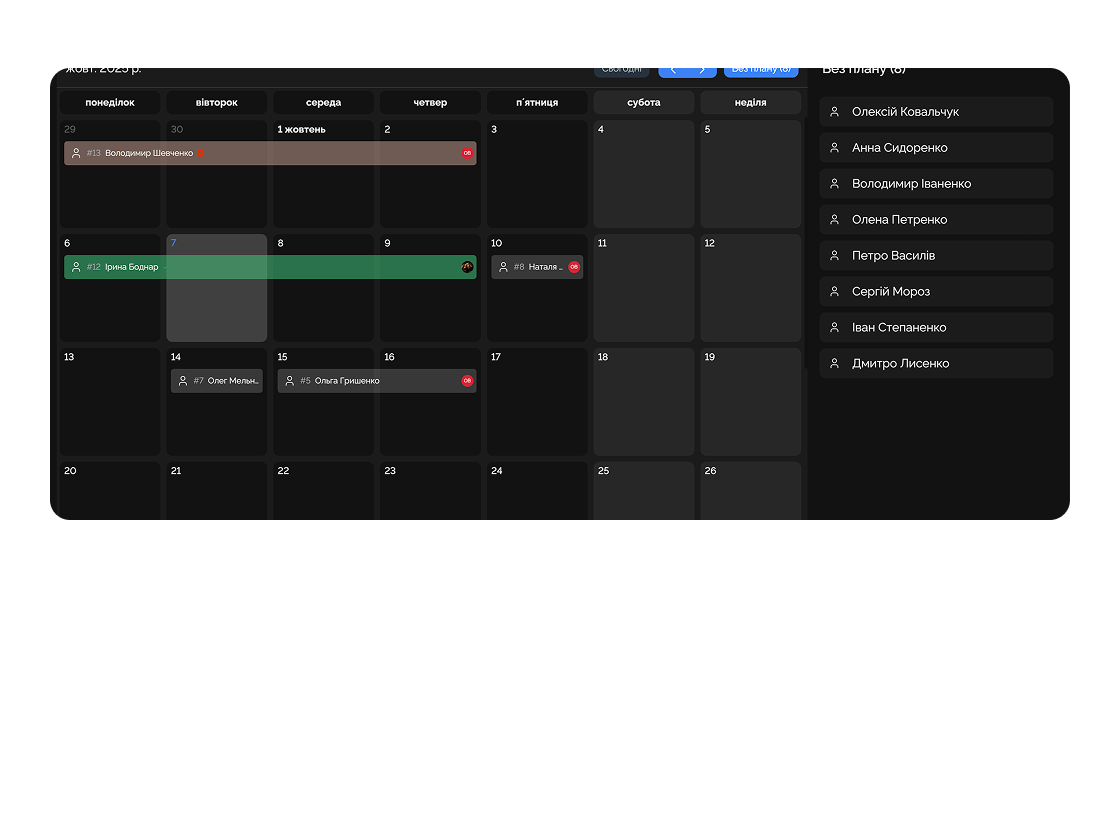
Easylim helps service businesses effectively manage staff, client records, and internal coordination — simple, convenient, and without chaos.
Built for
By the numbers
+25%
repeat-client rate
customer data
−60%
time on admin
Easylim CRM
5 min
to onboard a new staffer
2025 survey
Bookings, schedules, team — all in one window. No spreadsheets, no Viber groups.
Feature 01
Record client data and control interactions with them.
Feature 02
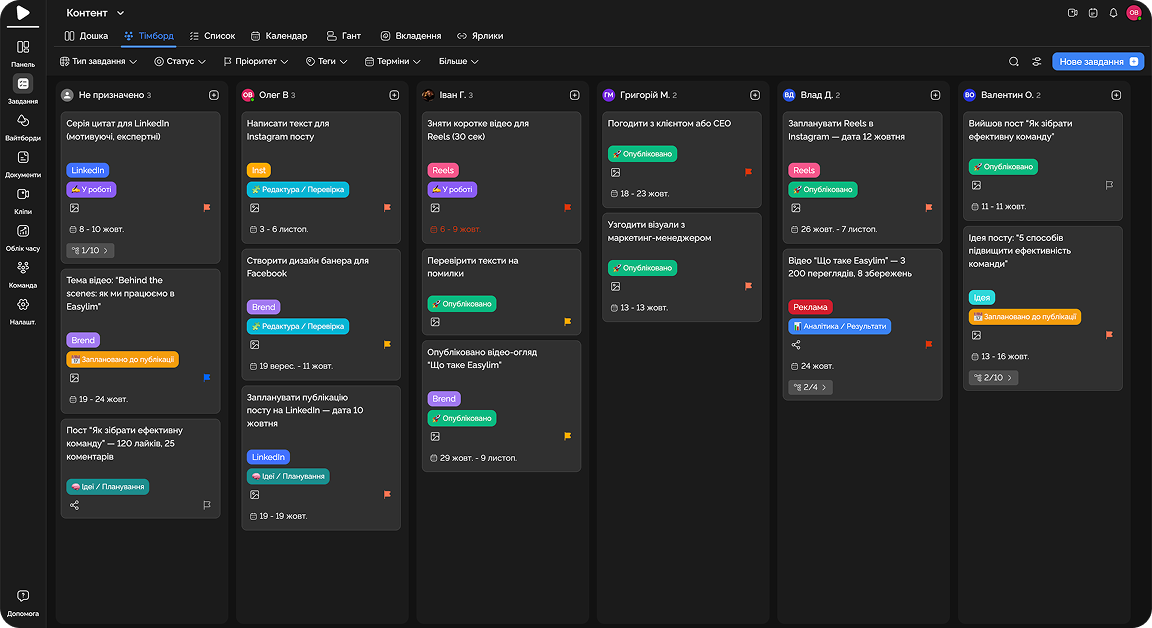
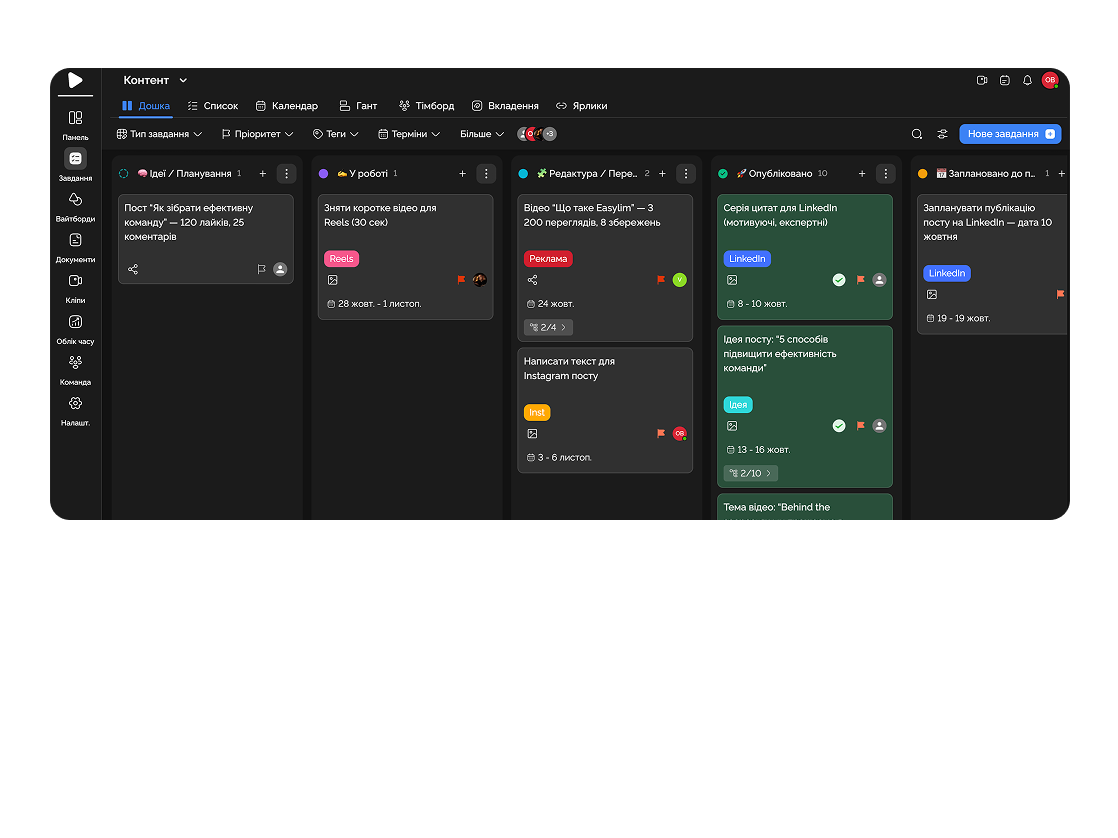
Assign tasks, track progress, and create a transparent team workflow.
Feature 03
Plan the day, adjust schedules, leave notes — all within a single system.
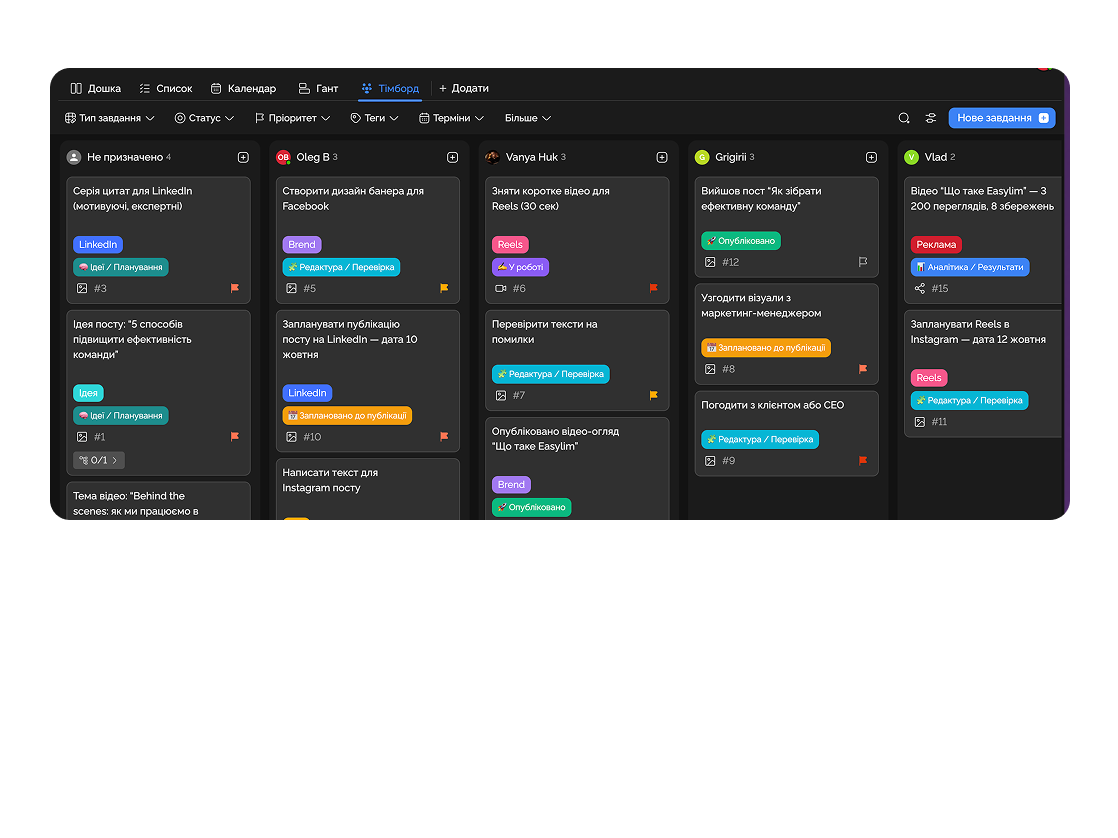
Feature 04
Monitor team workload and track all tasks.
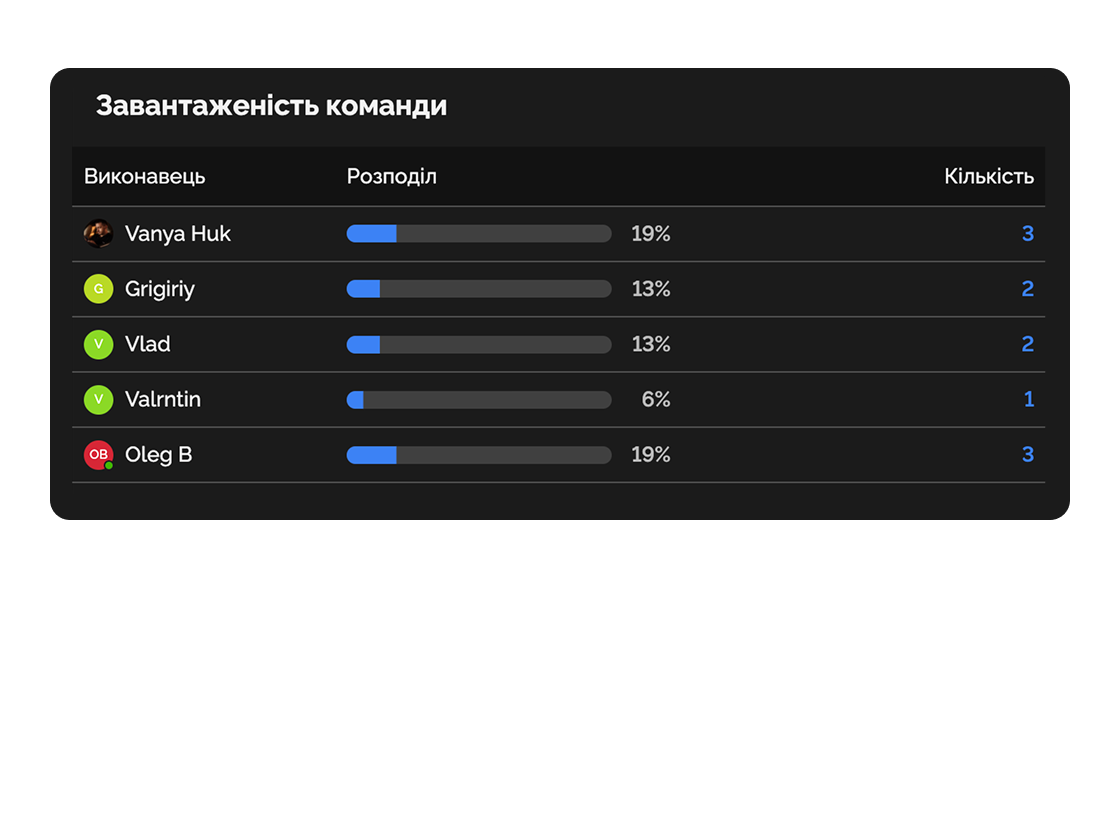
Bookings, staff control, and scheduling without errors.

Manage trainers, track task completion, and coordinate schedules.

Deep dive
5 chapters
A 10-to-40 person consumer brand always looks the same on the inside: support replies from Gmail, marketing plans launches in Notion, growth tests hypotheses in Airtable, and the CEO opens Slack at 8am to say "conversion dropped". That stack survives six months. After that, this guide describes how to put SLA tickets, launch checklists, growth experiments and the NPS loop on the same workspace — and when you finally do need to buy Zendesk.
Розділ
Bad support costs more than the lost customer: one negative review on Google or Trustpilot drags roughly 15 prospective orders down with it. Most "bad" support cases are not about the difficulty of the question — they're about response time. "Replied in two days" already convinces the customer you're a toxic brand.
A working support inbox needs three things: an SLA timer on every ticket, a status (new → in progress → waiting on customer → resolved) and a link to the underlying order. Without the SLA, agents pick the easy tickets and "forget" the hard ones. Without "waiting on customer" you can't tell a silent agent from a ball that is, legitimately, in the customer's court.
In Easylim tickets are the same task type as marketing campaigns, with an "order_id" custom field and an inbox-style filter. That keeps the link between a support case and a product bug ("five customers wrote about the same promo code") visible across the team — the agent files a product task in one click instead of dropping a message into a Slack channel that scrolls away.
Olena · order #88412
Marko · order #88408
Iryna · order #88399
Yurii · order #88395
Розділ
A product launch is not "hit a button"; it's thirty days of coordinated moves: creator briefs, landing page, email warm-up, paid media, PR. If those moves live across separate Notion pages, the chance of missing one critical step (e.g. Stripe is not configured for the new SKU) is roughly 100%.
A working launch checklist is organised around T-30, T-7, T-0 and +7. Each point has a named owner, a concrete artefact (landing live, samples shipped, ads scheduled) and an automatic ping the day before. The +7 point matters as much as T-0 — that is when you collect UGC, analyse launch data and start retargeting.
In Easylim that's a project template: spin up "summer drop" and the template instantiates 40 tasks tagged T-30 / T-7 / T-0 / +7 with default owners. The next launch is not from scratch — it's a copy of the template with corrections. A year later you have a tuned process instead of twelve chaotic launches.
until launch
Розділ
Without structure a growth team debates every idea on its own merits: "should we try discounts?" — an hour-long meeting. The ICE framework (Impact × Confidence × Ease, each from 1 to 10) gives you a single number for prioritisation: an idea scoring 720 ships before an idea scoring 240, regardless of who pitched it.
The board has four columns: Ideas → Running → Analysing → Shipped. Cap "Running" at two experiments at once — beyond that you can't honestly attribute lift. "Analysing" is the period where you wait for statistical significance (typically 14 days or 1,000 conversions per variant).
"Shipped" is not the end — it's the entry into a hypothesis knowledge base: what worked (lift, p-value), what didn't. Six months in you have a playbook that fits your brand specifically — which is roughly ten times more valuable than reading other people's case studies.
TikTok seeding · 12 creators
28paid
Bundle pricing test
50Abandoned-cart SMS
50day 4/14
Homepage hero variant B
43p=0.04
Free-ship threshold $40
49+11% AOV
Розділ
Everyone has an NPS number on a dashboard. An NPS loop — few do. Without the loop, NPS is a CEO vanity metric with zero product impact. With the loop it becomes a mechanism that adds two or three product improvements every month, sourced from real customer wording.
The four-step loop: Collect → Tag / triage → Respond → Improve. Collection is one in-app or email question sent 7 days after the first order. Tagging is automatic (by score 0–6, 7–8, 9–10) plus manual (by theme: delivery, quality, price). Reaching detractors within 48 hours saves roughly 30% of them.
The non-negotiable step is the fourth: the month's top theme becomes a roadmap card. Without that the loop breaks and the support team stops bothering to tag. In Easylim NPS responses are a task type with tags; aggregation lives on the Dashboard, and turning the top theme into a roadmap card is two clicks.
Collect
email · in-app · 1 question
Tag / triage
auto-route by score + theme
Respond
reach detractors in 48h
Improve
top theme → roadmap card
Promoters
62%
Passives
23%
Detractors
15%
Розділ
Once you hit ~500 tickets a day with a 10+ agent rotating team across time zones, Easylim stops being the right tool. Zendesk, Intercom and Front are tuned for exactly that case: skill-based routing, voice, NLP chatbots, post-contact CSAT, macros for typical replies.
The second boundary is regulated support (fintech, medtech, insurance), where every contact has to be logged, audited and kept for seven years. You need a helpdesk with compliance certifications (SOC 2, HIPAA), not a general project tool.
For early-stage D2C brands (under ~50 tickets a day, fewer than 5 agents) Easylim usually wins: tickets live next to the roadmap and growth experiments, so on Monday morning you can see the full picture of "what hurts customers → what we're doing about it". A separate helpdesk at this stage adds $400–800/month and one more tab to the team. Mechanics live in Kanban, Dashboard and Custom statuses.
Easylim connects to the apps your team already lives in.
Other industries
No card required. Free tier forever.


